
What Is a Gridline Bong & Why Do They Stack So Hard?
Posted by Jay on 28th May 2026
Scientific glass bongs have become one of the most popular styles of functional glass thanks to their smooth airflow, clean aesthetics, and impressive diffusion. Among all the different perc styles available today, few have built a bigger following than the gridline bong.
Known for massive bubble stacking, low drag, and incredibly smooth function, gridline tubes have become a favorite among both casual smokers and serious glass enthusiasts. But what exactly is a gridline perc, and why do these tubes function so differently from traditional bongs?
In this guide, we’ll break down what a gridline bong is, how gridline percs work, why they stack bubbles so aggressively, and how to get the best performance from your setup.
What Is a Gridline Bong?
A gridline bong is a type of scientific glass bong that uses a gridline perc, sometimes called a gridded inline perc, to diffuse smoke through water.
The “gridline” refers to the rows of precision-cut slits with small bridges of glass between creating a “grid” found along the diffuser. Instead of forcing smoke through one or two large openings, a gridline perc spreads airflow across dozens of small holes for smoother diffusion and reduced drag.
Most gridline bongs are built as straight tube bongs because straight tubes provide a streamlined path for bubble stacking and low internal volume for fast, efficient clearing. This combination creates the low-drag, effortless pull that scientific glass enthusiasts look for.
Gridline tubes are especially popular among flower smokers because they preserve flavor while still delivering strong diffusion and cooling.
What Is Bubble Stacking?
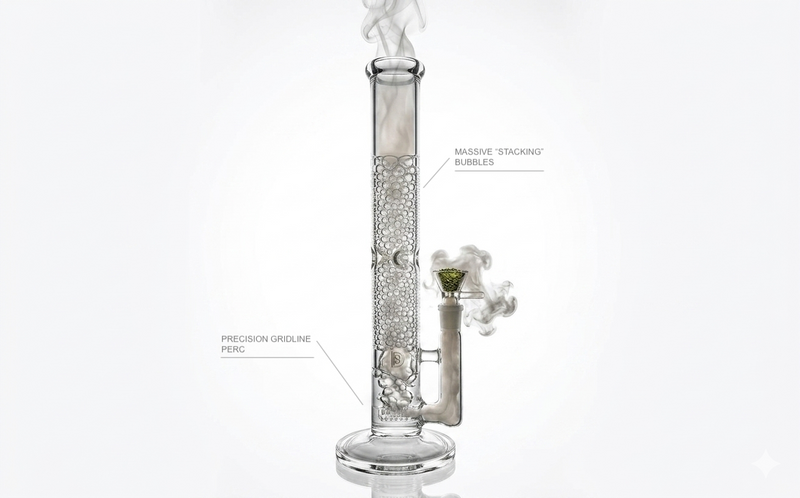
Bubble stacking refers to the dense columns of bubbles that form inside a bong while inhaling. In the scientific glass community, strong stacking is often seen as a sign of good airflow and proper function.
When a gridline bong is functioning correctly, the bubbles rise evenly through the tube in tightly packed layers instead of producing random splashing or uneven chugging.
Good bubble stacking usually indicates:
- Maximum diffusion
- Balanced airflow
- Reduced drag
- Even gridding execution
- Proper water level
While stacking looks impressive visually, it also helps create smoother and more consistent hits.
Why Do Gridline Percs Stack Bubbles So Well?
Gridline percs stack bubbles so effectively because airflow is distributed evenly through many small evenly distributed holes. As smoke passes through the perc, each hole creates a small stream of bubbles that combines into dense, uniform stacks traveling upward through the tube. Most gridline percs are also paired with straight tubes, whose narrow vertical design creates the ideal environment for consistent bubble stacking.
The result is a smooth hit that clears quickly without feeling overly restricted.
Compared to older diffused downstem designs, gridline percs generally feel more open and less “chuggy,” which is one reason they became so popular in the scientific glass scene.
Are Gridline Bongs Smoother?
Yes, most gridline bongs are considered smoother than traditional non-diffused tubes or basic downstem setups.
Because the smoke is broken into many smaller bubbles, there is more surface area exposed to the water. This cools the smoke more efficiently while helping remove harshness from larger hits.
Gridline percs also create a more even and consistent diffusion pattern. Instead of producing a few large aggressive bubbles, the smoke is dispersed through dozens of smaller streams, which helps soften the hit before it reaches your lungs. The result is a cooler, less harsh inhale that still maintains strong airflow and flavor.
This balance between diffusion and airflow is one of the main reasons scientific glass enthusiasts prefer gridline tubes over more restrictive or chug-heavy perc styles.




Do Gridline Percs Reduce Drag?
One of the biggest reasons enthusiasts love gridline percs is their ability to reduce drag while still maintaining excellent diffusion.
Drag refers to the resistance you feel when inhaling. Some heavily diffused bongs can feel tight or difficult to pull through, especially if the perc design restricts airflow.
Gridline percs are designed to maximize airflow by spreading diffusion across many small holes evenly. This creates smoother pulls while allowing the tube to clear quickly and effortlessly.
Many smokers describe gridline tubes as:
- Airy
- Open
- Fast-clearing
- Responsive
- Low resistance
This low-drag feeling is a major reason why straight tube scientific glass became so popular among experienced smokers.
Why Is My Gridline Perc Not Stacking?
If your gridline bong is not stacking properly, there are usually a few common causes.
Too Much Water
Overfilling is the most common issue. If the water level sits too high above the slits, airflow becomes restricted and stacking performance drops.
Too Little Water
If the slits are barely covered, the perc may not diffuse evenly and the bubbles can become inconsistent.
Dirty Perc
Resin buildup inside the slits can reduce airflow and disrupt bubble formation. Gridline percs function best when cleaned regularly.
Uneven Surface or Tilted Tube
If the tube is tilted too far to one side, the water may not distribute evenly across the perc.
Poor Perc Design
Not all gridline percs are created equally. High-quality scientific glass usually functions much better because the slit / grid spacing and airflow geometry are more precise.
Practice Makes Perfect
Getting the best stack out of a gridline tube takes a little practice. Unlike a chuggy bong that can handle aggressive pulls, gridline tubes function best with a smooth, steady inhale.
Think of it like the Goldilocks zone for airflow — pull too hard and the stack becomes turbulent, pull too soft and the perc will not fully activate. The sweet spot is an even, controlled pull that allows the bubbles to form dense, uniform stacks all the way up the tube.
Once you find that rhythm, it becomes easy to see why scientific glass enthusiasts love the smooth airflow and effortless function of a well-designed gridline tube.
How Much Water Should You Put in a Gridline Tube?
The ideal water level for a gridline tube is usually around an inch above the top of the perc. You want enough water to fully activate the diffusion without drowning the airflow.
As a general rule:
- Test airflow before use
- Adjust water levels gradually
- Fine-tune based on your preferred pull
Too much water can make the tube feel restricted and reduce bubble stacking performance, while too little water can create harsher hits and uneven diffusion.
That said, there are no hard rules. Some users intentionally “drown” the perc with extra water because it creates a completely different style of hit — typically more resistance, more chug, and heavier diffusion. Others prefer lower water levels for maximum airflow and cleaner stacking.
If bubble stacking is your goal, finding the perfect water level takes a little experimentation. Even small adjustments can noticeably change airflow, function, and the overall feel of the tube, which is why scientific glass enthusiasts often fine-tune their water levels carefully.
Why Scientific Glass Smokers Love Gridline Tubes
Gridline tubes became popular because they combine strong function, clean aesthetics, and efficient airflow in one simple design.
For many smokers, they offer the perfect balance between:
- Smoothness
- Flavor
- Diffusion
- Fast clearing
- Low drag
- Visual function
The combination of bubble stacking and responsive airflow helped make gridline percs one of the most respected styles in scientific glass.
Whether you’re new to scientific glass or looking to upgrade your current setup, a well-made gridline bong remains one of the most versatile and enjoyable options available today.